Ask a room of profitable traders what matters most, and almost none will say their entry strategy. They'll say risk, and at the heart of risk sits one skill: position sizing. Get it right and you can survive a brutal losing streak. Get it wrong and a single trade can undo months of work.
The good news? The maths is genuinely simple. By the end of this article you'll be able to work out the correct position size for any trade in under a minute, and understand exactly why it keeps your account alive.
What "position size" actually means
Your position size is how big a trade you take, measured in lots. One standard lot is 100,000 units of the base currency, a mini lot is 10,000 units (0.1 lots), and a micro lot is 1,000 units (0.01 lots). (New to these? See forex lot sizes explained.)
Why does it matter so much? Because lot size decides how much money each pip of movement is worth. Trade one standard lot of EUR/USD and every pip is worth about $10. Trade a micro lot and it's about $0.10. Same chart, same stop loss, yet wildly different risk. Position sizing is how you choose your risk before the market chooses it for you.
The position size formula
Everything comes down to one relationship:
Three inputs, three decisions:
- Risk amount: the cash you're willing to lose if the trade fails. Usually a fixed percentage of your account (more on that below).
- Stop loss in pips: the distance from your entry to where you'd admit you're wrong and exit.
- Pip value per lot: how much one pip is worth for the instrument you're trading (about $10 per standard lot on most USD pairs).
A worked example
Let's make it concrete. Say you have a $10,000 account and you've decided to risk 1% per trade, which is $100. You spot a EUR/USD setup with a 20-pip stop loss.
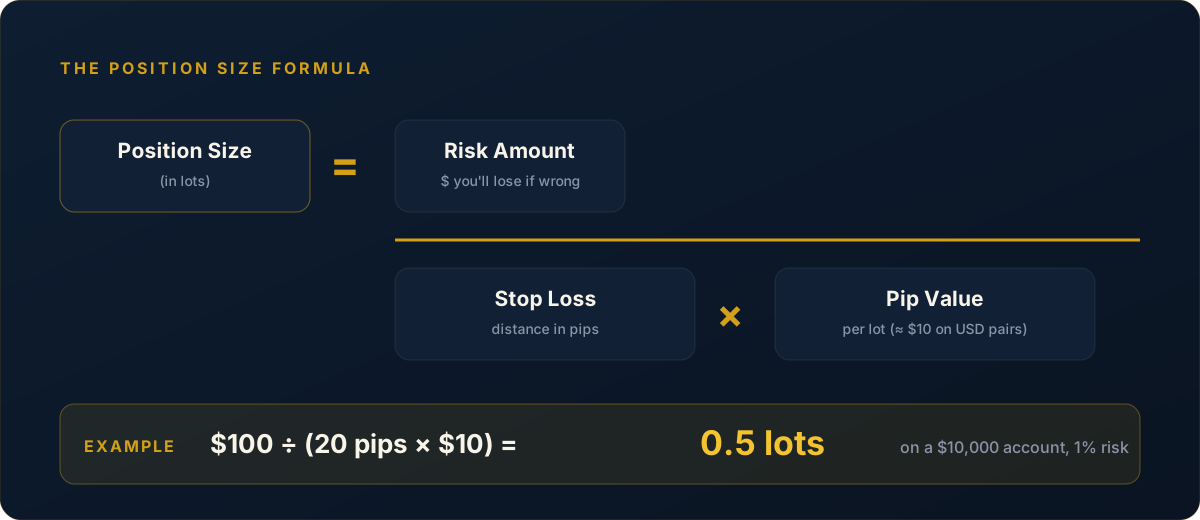
That's it. A half-lot position means if your 20-pip stop is hit, you lose exactly $100, the amount you decided in advance, no more. If price runs 20 pips the other way, you've made $100. The maths did its job before you ever clicked buy.
The point of position sizing isn't to win more. It's to make sure no single loss can ever take you out of the game.
Want a quick reference for your balance? See what lot size to use for a $100, $500 or $1,000 account.
Don't do this by hand every trade
Our free calculator runs this exact formula for forex, gold, oil and indices, and pulls in the live price for you.
Open the Lot Size CalculatorHow much should you risk per trade?
This is the input that quietly decides whether you last. The professional consensus is 1% or less per trade, and rarely above 2%. It sounds conservative, and that's the point. (We cover the survival math in full in the 1% risk rule explained.)
Here's why small risk matters so much: losses compound against you. A 50% drawdown doesn't need a 50% gain to recover. It needs a 100% gain, because you're rebuilding from a smaller base. (We broke this down in depth with the loss recovery calculator.) Keep each loss to 1% and even ten losses in a row barely dents you. Risk 10% a trade and three bad trades put you in a hole that's mathematically brutal to climb out of.
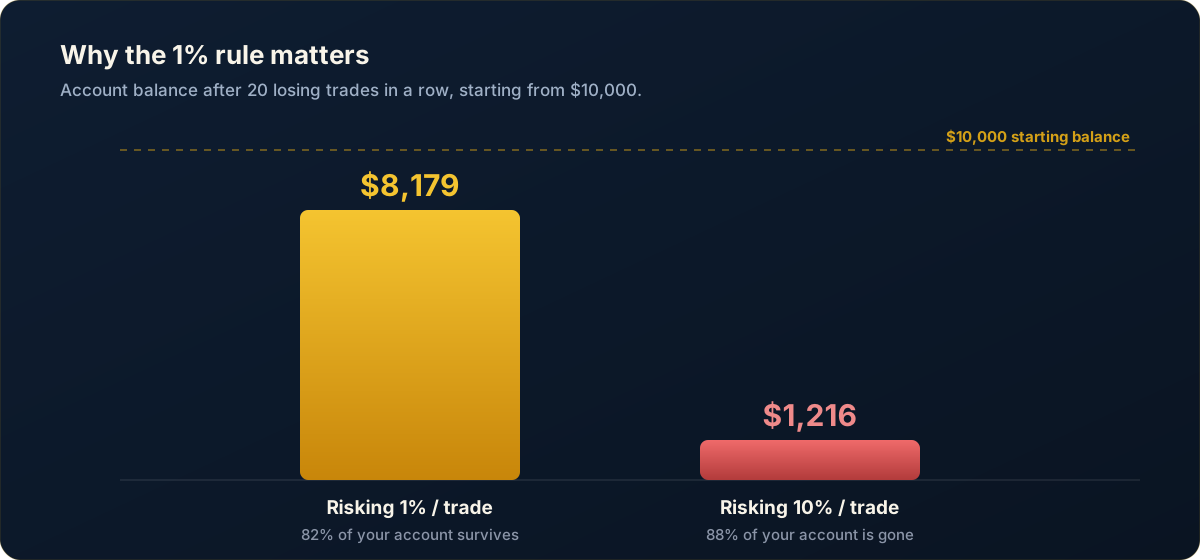
The 1% rule in numbers
On a $10,000 account, risking 1% means a $100 maximum loss per trade. You could lose 20 trades in a row and still have 80% of your account. That survivability is what lets a positive edge actually play out over hundreds of trades.
Does it work for gold, indices and oil?
Yes, the logic is identical, but the pip (or "point") value changes per instrument. Gold, oil and indices have different contract sizes than forex pairs, so a "20-point" stop on the Dow is a very different dollar risk than 20 pips on EUR/USD. Always confirm the contract specs with your broker, or let the calculator handle the conversion for you.
Common position-sizing mistakes
- Fixed lot size on every trade. A 15-pip stop and a 60-pip stop are not the same risk if you trade the same lots. Size to the stop, not out of habit.
- Widening the stop to "fit" a bigger position. That's risk management in reverse. Decide your stop from the chart, then size to it.
- Risking too much to "make it back." Revenge sizing after a loss is how small drawdowns become account-enders.
- Ignoring leverage and margin. A correctly-sized position can still exceed your available margin on high leverage, and the calculator flags this.
The bottom line
Position sizing isn't glamorous, but it's the difference between traders who are still here next year and traders who aren't. Decide your risk as a small, fixed percentage. Set your stop from the chart. Then size the position so the two line up. Do that consistently and you've already beaten most of the field.
Put it into practice
Plug your own balance, risk and stop into the free calculator and get your exact lot size in seconds.
Calculate my position sizeFrequently asked questions
What is position size in forex?
What is the formula for position size?
How much should I risk per trade?
This article is for educational purposes only and is not financial, investment or trading advice. Trading forex and CFDs carries a high level of risk and may not be suitable for all investors; you can lose more than your initial deposit. Always do your own research and never risk money you cannot afford to lose.